How to Combine Names for a Business | Proven Techniques That Work
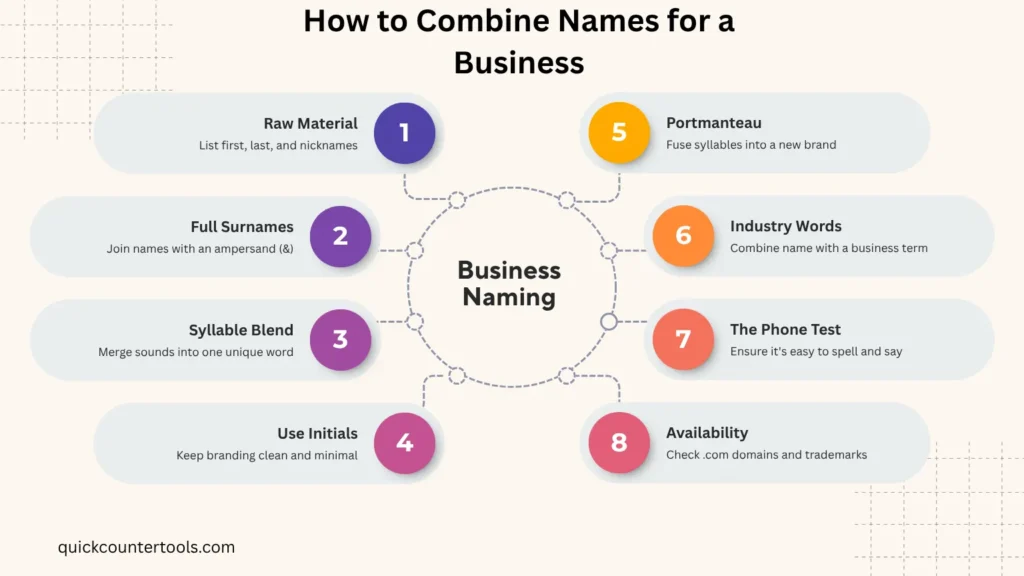

How to combine names for a business effectively means taking two or more personal names, such as founder names, partner surnames, or family names, and merging them into a single, cohesive brand identity.
This approach has produced some of the most recognizable company names in history, from law firms to global tech giants. Today, it remains one of the most practical naming strategies for small businesses, partnerships, and family-owned brands looking for immediate market credibility.
Why Businesses Combine Names in the First Place
A name built from real names carries something a coined word cannot: immediate human credibility. Ben & Jerry’s, Johnson & Johnson, Hewlett-Packard, and J.P. Morgan all signal partnership, ownership, and accountability in the name itself.
For small businesses and startups, this matters more than most owners realize. When a customer sees two names on a storefront or website, they understand that real people stand behind the product. That kind of brand storytelling is difficult to manufacture with an invented word.
There is no single correct method; the best technique depends on how formal, personal, or inventive the final name needs to be.
The most straightforward approach is joining two surnames directly: Mills & Carter, Park & Reed, or Santos & Hale. This format is common in law firms, accounting practices, architecture studios, and design agencies—industries where professional credibility matters more than brand novelty.
Instead of listing both names in full, take a syllable or sound cluster from each and merge them into one word the Name Combiner automates this process using syllable logic, so you can generate multiple blended variations without manually experimenting with every possible combination. It supports three blend styles: Equal Mix, More First, and More Second, which is useful when one name should carry more weight in the result.
Initials work when the full names are too long to combine naturally. Two partners named Alexander Thompson and Rebecca Nguyen might simply go with “ATN Studio” or “ATRN Group.” This approach is clean and minimal but can feel anonymous until the brand builds recognition over time.
The risk with initials is that they rely entirely on brand-building to carry meaning — they communicate nothing on their own at launch.
A portmanteau takes sounds and syllables from two names and fuses them into a single new word that does not look like either original name. This is how Verizon was created from ‘horizon’ and ‘veritas,’ though the same principle applies to personal names.
Two founders named Sandra and Miguel could produce ‘Sandri,’ ‘Migra,’ or ‘Sanguel’ depending on which syllables dominate. The result feels invented but carries the DNA of both names underneath.
Portmanteau names require the most testing; always check the result for unintended meanings, especially if your business operates internationally.
Combine a Name with an Industry Word
Mixing a personal name with a word that describes the business is another reliable method. A florist named Chen might open “Chen Bloom.” A photographer named Arias might use “Arias Lens.” The name stays personal while immediately communicating what the business does.
This method works especially well for service businesses where the owner is the primary brand. The Combined Words Generator can help if you want to test variations that mix a name root with industry-related terms quickly.
Write out every version of the names you are working with: full first names, last names, shortened versions, and nicknames. Two founders named Elizabeth and Robert produce Liz, Beth, Eliza, Rob, Bob, and Robbie, plus all the surname variations.
More raw material means more useful combinations when you run them through a tool or work through them manually.
Match the technique to the brand’s intended tone:
| Blending Method | Best For |
| Full surnames + ampersand | Professional services, law, finance |
| Syllable blend (portmanteau) | Startups, tech, creative studios |
| Name + industry word | Solo practitioners, service businesses |
| Initials | Established firms, corporate brands |
If you are unsure which method fits, generate options from multiple methods before narrowing down.
Step 3: Apply the Phone Test
Read each candidate name aloud, as if you were introducing your business on a phone call. The name should pass three checks:
Names that fail any of these checks tend to create friction in every customer interaction — on calls, in referrals, and when people try to search for the business online.
Before announcing any name publicly, verify it across four channels:
| Check | Where to Do It |
| .com domain | Any domain registrar |
| Social media handles | Instagram, Facebook, X (Twitter) |
| State business name | Secretary of State website |
| Federal trademark | USPTO Trademark Search |
If the .com domain is taken, that is a signal, not a technicality. A taken domain usually means the name is already in active commercial use. Go back to the generator rather than settling for a hyphen or alternate extension.
Combining names:
Without checking pronunciation, two names that look good together on paper can be difficult to say together or produce a sound cluster that feels awkward in normal speech.
Skipping the trademark check:
A name that is free as a domain can still be federally trademarked in your industry. Using a trademarked name, even unknowingly, creates legal exposure.
Combining too many names:
Three founders, three names in the business name—the result is almost always too long. Two names are the practical ceiling for a combined business name. If there are three founders, one approach is to blend two names into a portmanteau and let that represent the group.
Qualities of a Strong Combined Business Name
Not every result from a name combination process is worth using. Strong combined names share these characteristics:
The name combiner for 4 names on Quick Counter Tools is built specifically for this task. It takes two to four personal names and generates pronounceable blends using syllable logic, producing results like a startup name that honors both founders, a couple’s ship name, a gaming squad tag, or a family business name.
If you want to move beyond personal names and explore compound word options or industry term combinations, the Word Combiner handles that separately. For output aimed specifically at startup branding and business-ready name formats, the Brand Name Generator narrows results toward commercial use cases.
All three tools are free and accessible from the Quick Counter Tools homepage.
Combining names for a business works because it anchors a brand in something real — the people behind it. The most effective combined names are short, pronounceable, and available as a .com domain.
The Name Combiner gives you a fast, structured way to test syllable-blended combinations across different styles without manual guesswork.
How do I combine two names for a business name?
The most common methods are joining full surnames with an ampersand, blending syllables from both names into one new word, using initials, or adding an industry word to one name. The method that works best depends on how formal or inventive the brand needs to be.
What is the best way to merge founder names into a business name?
Syllable blending tends to produce the most brandable results for startups. Take a strong syllable from each founder’s name and combine them into one pronounceable word. The Name Combiner automates this using syllable logic across three blend styles.
Can I use both partners’ names in a business name?
Yes. Two-name business names are common across industries — from professional services to family businesses. The key is keeping the combined result short enough to be memorable and easy to pronounce on first contact.
What are examples of businesses named after combined founder names?
Ben & Jerry’s, Hewlett-Packard, Johnson & Johnson, and J.P. Morgan all use some form of combined personal names. Each communicates partnership and accountability directly through the brand name.
How do I know if a combined business name is already taken?
Check the .com domain availability through a registrar; search social media handles on Instagram and Facebook; X; look up the name in your state’s Secretary of State database; and run a trademark search through the USPTO for federal conflicts.
🗂️ Recent Posts




